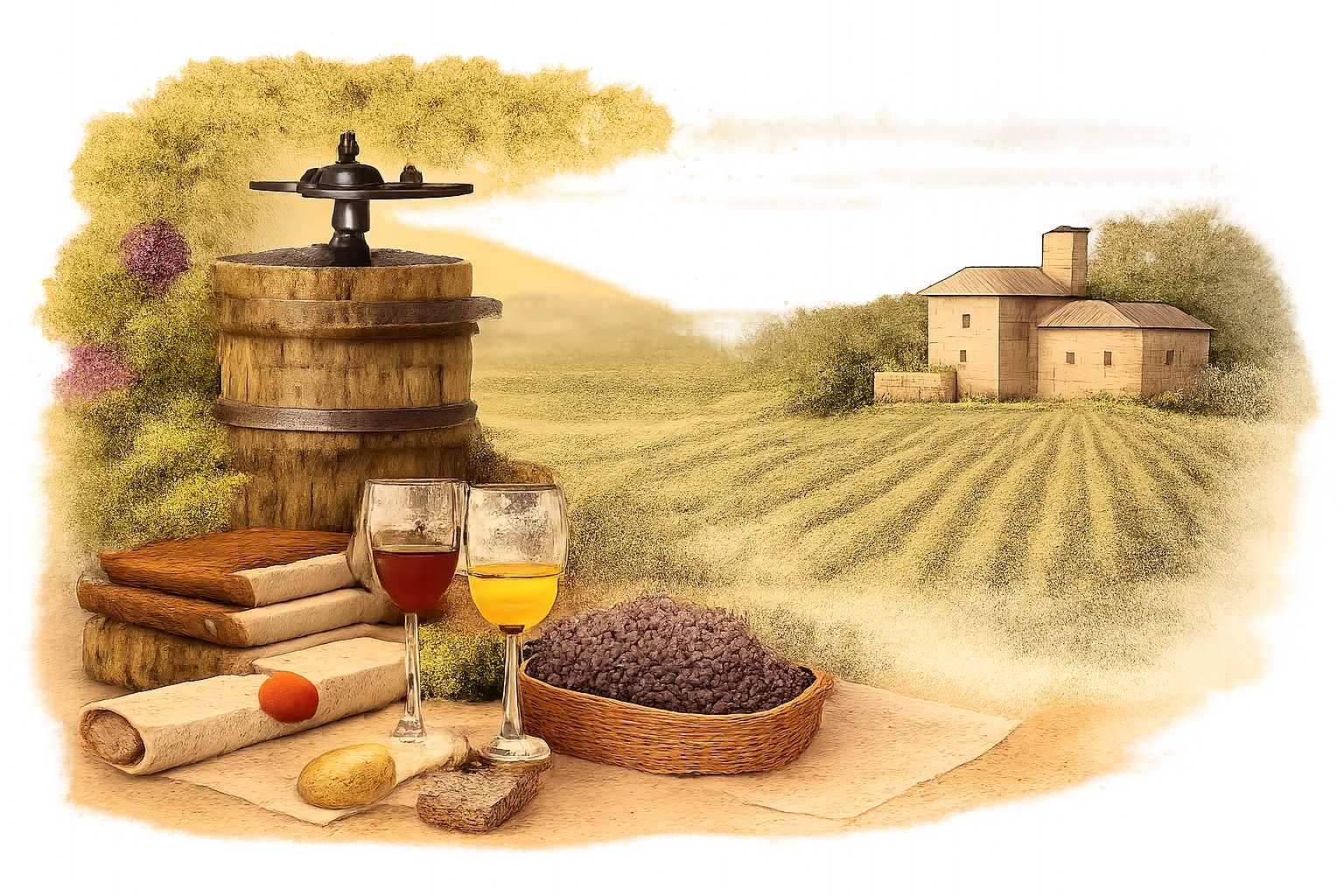
Our History
KISLOV is a boutique winery from Bender with a century-long history. The production combines family heritage with modern technologies, creating limited-edition wines of premium quality. Each vintage is released in small quantities, and the wines are distinguished by purity of taste, elegant style, and a recognizable expression of terroir.
Milestones
- 1914
Origins
Alexander Grigoryevich Kislov buys land at the foot of Suvorov Hill in Bendery and founds the winery estate — the start of a family story now over a century old.
- 1946
A test of time
The estate is nationalized into a collective farm, but Alexander Grigoryevich stays at the helm, guiding the production process until 1962.
- 2014
Revival
The founder's great-grandson, Vladimir Kislov, revives the family business: the land is expanded, and the first vines — Cabernet Sauvignon, Merlot and Cabernet Franc — are planted on the historic site.
- Recent years
The wine bar
Vladimir's daughters — Alexandra and Elizaveta — open the KISLOV wine bar and shop in the centre of Bendery and grow wine tourism.
- Today
Today
KISLOV wines compete internationally and win professional awards, while the estate remains a true family business, generation after generation.
Foundation of the winery
Alexander Grigoryevich Kislov founded the winery in 1914. He was born in Kyiv in 1876 into a modest noble family. In 1892, he graduated from the Kyiv Gymnasium and was then sent to study at the Kherson Agricultural College, specializing in viticulture and winemaking, as he showed a strong interest in this field.
After completing his studies, Alexander Grigoryevich was conscripted into the Imperial Army. He took part in the Russo-Japanese War and defended Port Arthur, where he was taken prisoner.
After his release in 1907, he returned to Kyiv. On his way home, he traveled across much of the world, visiting New York, Amsterdam, and Odesa. Alexander Grigoryevich spent many years searching for land and a suitable climate for the work of his life.
In 1914, he purchased land at the foot of what is now known as Suvorov Hill on the outskirts of Bender and established a winery that remains in the same location to this day. By the time the vineyard was flourishing, the region of the former Russian Empire had come under Romanian administration, and the peak of the winery’s development occurred during the Romanian period.
Did you know that the label of KISLOV wine features a photograph of our great-grandfather, Alexander Kislov?
This photograph is over 100 years old.
It is reliably known that in its best years, the winery supplied up to 50 tons of wine material to Romania, where the wine was blended, bottled, and shipped to various cities, including Vienna, Warsaw, and Moscow. In 1946, Alexander Grigoryevich voluntarily transferred the entire estate, including horses and part of the farm buildings, to a collective farm, yet continued to oversee the winemaking process until 1962.
Modern History
A hundred years after the winery was founded, the family story found a new continuation. The great-grandson of Alexander Grigorievich, Vladimir Kislov, worked in the vineyard from an early age, absorbing the culture of the land and the subtleties of winemaking not from books, but through daily hands-on labor. For him, the vineyard was always a natural part of life, not an abstract tradition.
In 2014, Vladimir made the decision to revive the family legacy. The land was cleared, the estate restored, and new vines were planted on the historic site. Thus, the modern KISLOV winery was born — a continuation of the past with a clear vision for the future.
That same year, the first vines of Cabernet Sauvignon, Merlot, and Sauvignon Blanc were planted. Later, the vineyard expanded with the acquisition of new plots, where Chardonnay vines were planted. At the time of writing, their harvest has not yet taken place — the wine is still waiting for its moment.
Today, Vladimir Kislov is the head winemaker of the estate. He personally oversees every stage of the process: from vineyard care and harvest to vinification, bottling, and even the manual labeling of bottles. Each bottle is the result of personal involvement and full responsibility for quality.
Vladimir’s daughters, Alexandra and Elizaveta, have taken on the development of the business and its modern identity. They manage brand promotion, develop wine tourism, and organize tastings and themed events. Thanks to their efforts, KISLOV wines participate in international competitions and receive professional awards and medals.
In the center of the city of Bender, Alexandra and Elizaveta opened the KISLOV wine bar & vinoteca — a place where guests can discover the full range of family wines, as well as taste outstanding selections from other boutique wineries of Moldova.
Today, the KISLOV winery is a truly family-run enterprise. Every family member contributes in their own way: some work physically in the vineyards and winery, others manage logistics, events, and daily operations, while others — even from abroad — help develop digital platforms and modern communication channels.
Thus, a tradition laid down more than a century ago continues to live, evolve, and find new expression with each new harvest.
A Legacy of Fine Winemaking
Nestled in the heart of Moldova's wine country, Kislov Family Winery has been crafting exceptional wines for generations. Our story began with a simple dream: to create wines that capture the essence of our beloved land.
Today, we continue this tradition, blending time-honored techniques with modern innovation. Each bottle we produce is a testament to our commitment to quality and our deep respect for the art of winemaking.
«Wine is more than a drink. It is a memory of the land, the family, and the time we keep in every bottle.»
From vine to glass
Come and taste history for yourself
A tour of the winery, a tasting at the wine bar, and the story of a family that has kept its tradition alive for over a century.
Book a visit